When a mid-market shipper evaluates a new route optimization platform, their transportation director asks about algorithms and cost-per-mile savings. Their IT team asks one question first: what EDI transactions do you support, and how do they connect to our TMS? That question is not bureaucratic caution — it reflects hard-earned experience. The optimization logic is only valuable if it can pass work instructions to carriers and TMS platforms without requiring a dispatcher to manually re-enter every load. EDI is the plumbing that makes automation real.
The Four Core Transactions Every Mid-Market Shipper Needs
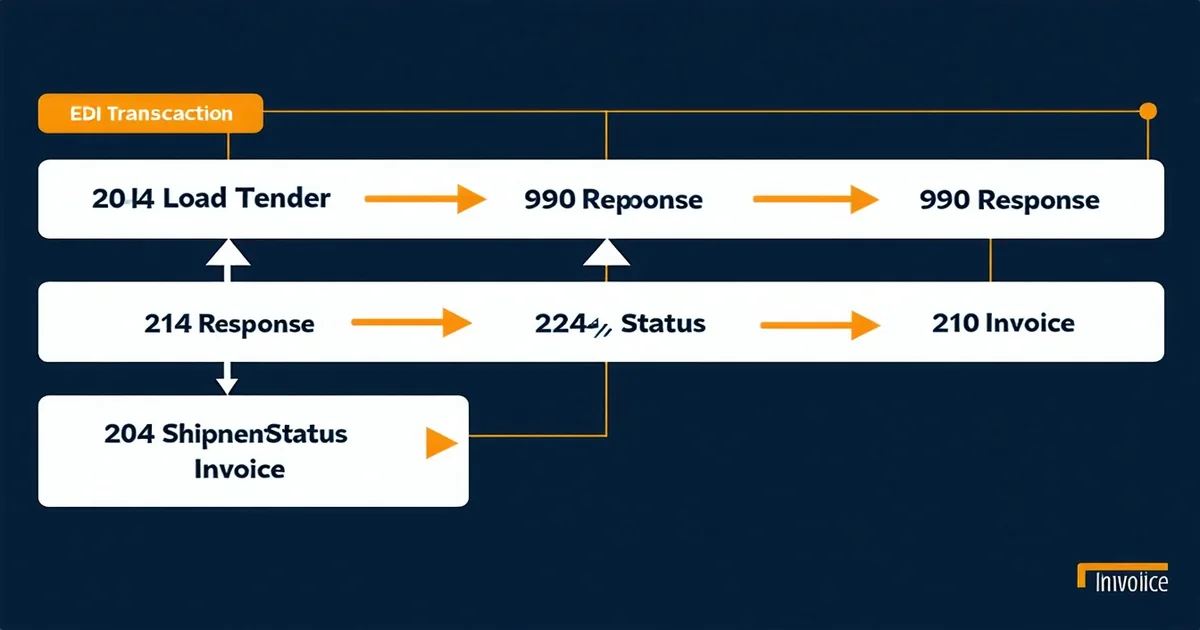
The ANSI X12 EDI standard encompasses hundreds of transaction sets. For mid-market shippers running FTL and LTL freight through a TMS, four transactions cover the majority of operational workflows: the 204, the 990, the 214, and the 210. Understanding what each one does — and where the hand-offs happen between shipper, carrier, and TMS — determines whether your integration actually automates work or just digitizes the same manual steps.
EDI 204: Motor Carrier Load Tender
The 204 is the shipper's instruction to a carrier: here is a load, here are the stop sequence and time windows, here are the commodity and weight details, here are the special instructions. It is the electronic equivalent of the phone call or fax that dispatchers were making until the mid-2000s, and in some smaller operations, are still making today.
For a route optimization tool, the 204 is the output transaction — after the solver produces an optimized route, it generates a 204 for each load and transmits it to the carrier or TMS. The key fields that matter for routing accuracy are the stop sequence (S5 segment), the time window at each stop (AT qualifier on the S5), the equipment type requirement (N7 segment), and the commodity description with weight and cube (L5, L0 segments). If your route optimizer is not populating these fields correctly from the solver output, you will have carriers showing up with the wrong equipment or outside the time window the receiver agreed to.
EDI 990: Response to a Load Tender
The 990 is the carrier's response to the shipper's 204. It carries one of four standard status codes: accept (A), conditional (C), decline (D), or pending (P). In an automated workflow, a carrier's TMS receives the 204, evaluates capacity against current commitments, and returns the 990 — ideally within minutes.
Where mid-market shippers run into problems is the conditional response. A 990C means the carrier will accept the load but with modified terms — adjusted pickup time, different equipment, revised rate. If your TMS is not parsing the conditional response and flagging it for dispatcher review, the modified terms get accepted silently and a driver shows up three hours outside the committed window. The 990 workflow sounds simple; the conditional path is where manual oversight is still required.
EDI 214: Transportation Carrier Shipment Status Message
The 214 is the tracking transaction — the carrier sends status updates throughout the shipment lifecycle. Standard status codes include X3 (arrived at pickup), X1 (picked up), X6 (out for delivery), X2 (delivered), D1 (refused by consignee), and a dozen exception codes for delays, redeliveries, and carrier errors.
The 214 is the transaction that feeds OTIF measurement. When your carrier sends an X2 (delivered) status with a timestamp, that timestamp is the ground truth for on-time measurement against the committed delivery window. If your TMS is not ingesting 214 status messages and mapping them to delivery commitments, your OTIF calculation is probably based on driver self-reported timestamps or ELD geofence data — which are reasonable proxies, but they are not the authoritative carrier confirmation.
EDI 210: Motor Carrier Freight Details and Invoice
The 210 is the carrier's invoice. It should correspond to the load defined in the 204, adjusted for any accessorials (detention, fuel surcharge, liftgate, limited access, residential delivery) that accrued during execution. The 210 auto-match process — comparing invoice line items against the original load tender and approved accessorial schedule — is where freight audit automation begins.
Mid-market shippers without automated 210 matching are typically reviewing carrier invoices manually, which takes 2–4 hours per week for a transportation analyst at moderate freight volume. The error rates in manual invoice processing run 3–8% of total freight spend, according to freight audit industry estimates. Automated 210 matching catches rate discrepancies, duplicate invoices, and unauthorized accessorials before payment rather than after.
The Broader EDI Ecosystem: Transactions You Will Encounter
Beyond the core four, mid-market shippers interacting with carriers, brokers, and 3PLs encounter several additional transaction sets:
- EDI 211 (Bill of Lading): The electronic BOL issued by the shipper. Some TMS platforms generate the
211automatically from204data; others require separate entry. In FMCSA-regulated operations, the BOL must be present with the shipment — the211is the electronic equivalent. - EDI 856 (Advance Ship Notice / ASN): The shipper's advance notification to the receiver that a shipment is en route, including contents and expected arrival. Retail DCs and large manufacturers require
856from their suppliers; failing to send an accurate ASN can trigger chargebacks of $50–$500 per shipment depending on the receiver's compliance program. - EDI 322 (Terminal Operations and Intermodal Ramp Activity): For shippers using intermodal, the
322carries gate events — container arrival at the rail ramp, chassis pickup, drayage dispatch, and gate-out confirmation. This transaction is less common in pure FTL operations but essential for intermodal network visibility. - EDI 214 exception codes: The
X8(shipment delayed) andAX(delivery appointment scheduled) status codes are particularly important for re-routing logic. When a carrier sends anX8with a projected delay, that is the trigger for a re-optimization run to assess whether other stops on the affected driver's manifest need to be re-assigned.
TMS Integration Architecture: What Mid-Market Actually Looks Like
Enterprise TMS platforms (Oracle OTM, MercuryGate, McLeod) handle EDI internally through their carrier EDI management modules. Mid-market shippers connecting to these platforms typically use one of three integration patterns:
Direct EDI over VAN (Value-Added Network): Both shipper and carrier are members of the same VAN (SPS Commerce, TrueCommerce, OpenEDI). Transactions route through the VAN's mailbox infrastructure. This is reliable and auditable, but per-transaction costs ($0.02–$0.10 per envelope) and VAN membership fees add up at scale.
Direct EDI over AS2: A direct machine-to-machine connection using the AS2 protocol, which wraps EDI payloads in encrypted HTTPS envelopes. This is standard for high-volume carrier relationships and eliminates VAN transaction fees, but requires certificate management and connection setup per trading partner.
REST API with EDI translation: Some TMS platforms and route optimization tools expose REST APIs and handle the EDI translation internally. The shipper sends a JSON load object via REST; the platform converts it to a 204 and transmits to the carrier. This is operationally simpler for the shipper but creates dependency on the platform's EDI translation accuracy and trading partner connectivity.
For a mid-market shipper with 30–100 active carrier trading partners, the typical architecture is VAN for the long tail of smaller carriers plus direct AS2 connections for the top 10–15 carriers by volume. A route optimization tool that plugs into this architecture needs to support both connection types cleanly.
Where Integration Projects Fail: Three Common Failure Modes
We are not saying EDI integration is harder than it needs to be — but it is harder than vendors typically represent in sales cycles. The three failure modes we see most often:
Trading partner setup time is underestimated. Every carrier trading partner requires a separate EDI setup process: ISA/GS qualifier exchange, mailbox provisioning, test transaction validation, and production cutover. A mid-market shipper with 40 active carriers realistically needs 8–16 weeks to complete trading partner setup, not the "2 weeks to go live" often quoted. Buffer accordingly.
Field-level mapping assumptions break on edge cases. The 204 specification allows significant flexibility in how fields are populated. One carrier's TMS might expect the pickup reference number in the B2A segment; another expects it in the L11 segment. These mapping differences are not visible until test transactions start failing, and debugging EDI mapping errors requires someone who reads X12 syntax fluently. Plan for a 2–3 week mapping debug cycle per new trading partner.
Conditional 990 responses need human workflow. As noted above, the 990C conditional response requires dispatcher review. If the integration assumes all 990 responses are binary accept/decline and auto-accepts conditionals, loads will be assigned on modified terms the shipper never reviewed. This is the most common source of carrier invoice disputes in EDI-integrated operations.
Practical Integration Checklist Before You Evaluate Vendors
Before evaluating route optimization or TMS platforms on integration capability, confirm you have answers to these questions:
- Which of your carrier trading partners are already EDI-capable, and through which VAN or direct connection?
- What EDI transactions does your current TMS emit and receive natively?
- Do you have an EDI coordinator or freight analyst who can manage mapping projects, or will you need vendor implementation support?
- What is your current process for handling carrier
990Cconditional responses? - Are you sending
856ASNs to receivers who require them, and is your current TMS generating them from load data or manual entry?
Vendors who can give clear answers about their trading partner connectivity, their EDI transaction support (not just "we support EDI" but which specific segments of the 204 they populate and validate), and their conditional response workflow are vendors who have actually implemented these integrations in production. Those who speak only in generalities about "EDI connectivity" typically mean they support the base 204/990 cycle on a small set of pre-connected carriers. That matters when you are evaluating the difference between a 6-week and a 6-month integration timeline.