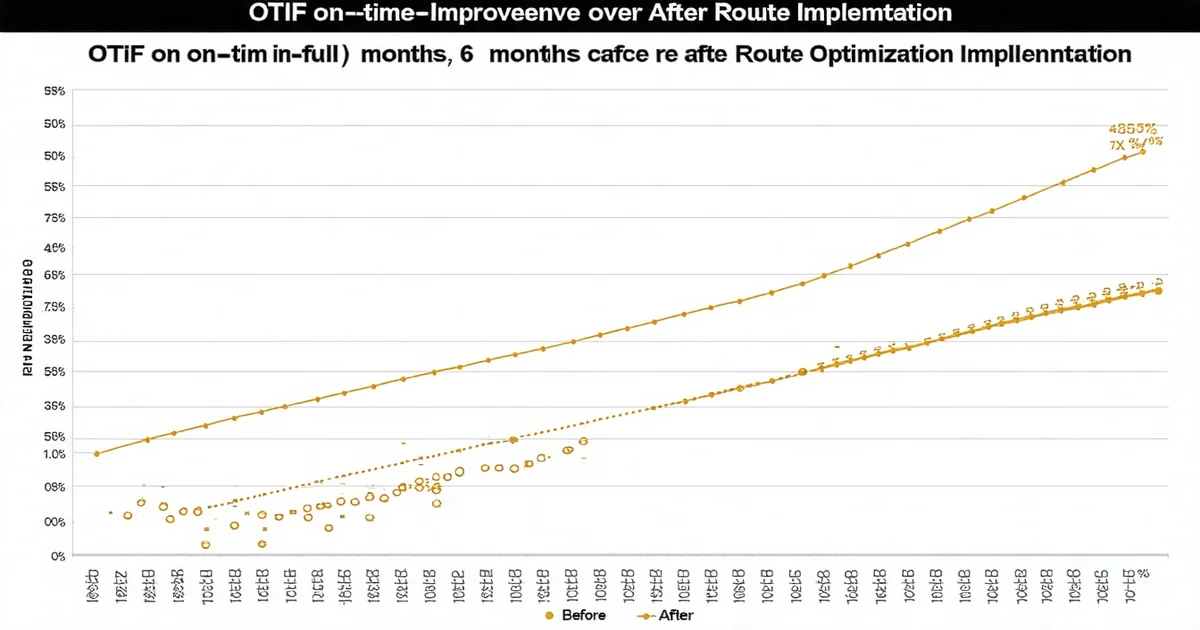
OTIF — on-time in-full — is the KPI that most clearly connects freight operations to customer revenue. Retail customers with OTIF compliance programs issue chargebacks for every missed delivery. Manufacturers shut down production lines when components arrive late or short. A regional grocery chain that drops from 93% OTIF to 87% with a supplier is not just noting a performance problem — they are likely initiating a vendor scorecard review that ends with an allocation reduction. The stakes are direct and measurable in a way that cost-per-mile is not.
Understanding OTIF as a Compound Metric
OTIF is often treated as a single number, but it is actually the product of two separate measurements: on-time percentage (OT%) and in-full percentage (IF%). A shipment that arrives on time but missing three of twelve line items is not OTIF-compliant. A shipment that arrives in full but 4 hours outside the delivery window is not OTIF-compliant. The compound metric — OT% × IF% — ensures both dimensions are tracked.
For freight operations teams, the relevant split is which dimension is causing OTIF failures. An OT% of 91% and an IF% of 97% produces an OTIF of 88.3%. An OT% of 97% and an IF% of 91% produces the same aggregate OTIF. But the remediation path is completely different: OT% problems are routing, dispatch timing, and carrier performance issues. IF% problems are order management, warehouse picking accuracy, and load confirmation issues. Route optimization addresses OT% directly and IF% only indirectly (by reducing service time variability that causes driver rushing and load errors). This distinction matters when you are diagnosing which part of your operation to fix first.
The Five Leading Causes of On-Time Failure
Operators we've worked with and observed in the mid-market segment consistently report the same failure patterns in their OT% data:
Late Departure from Origin
A driver who leaves the yard 45 minutes late because their pre-trip inspection ran long, or because dock loading ran behind, or because the dispatcher was still finalizing the manifest — that 45 minutes rarely recovers over a 12-stop route. Time windows compound forward: a late departure triggers a late first stop, which triggers a shortened window at the second stop, which triggers a cascading sequence of tight or missed windows through the afternoon. The dispatcher does not see the end-of-route consequences of the morning delay until it is too late to reassign stops.
Route planning systems that set departure time as a fixed variable in the optimization model — rather than treating it as a soft assumption — will produce routes that have no recovery buffer for a 30–45 minute departure delay. Planning with explicit departure buffer margins (building in a 20–30 minute departure cushion per driver) reduces the cascade effect significantly, at the cost of slightly lower theoretical route efficiency.
Dwell Time Underestimation
Standard TMS stop dwell time defaults — 15 minutes for delivery, 20 minutes for pickup — are accurate for accounts with dock scheduling, powered conveyors, and experienced receiving teams. They are completely wrong for independent retailers, small manufacturing sites, and any account that does not have formal dock management. Operators we've talked to report actual dwell times at unscheduled stops ranging from 12 minutes to 80 minutes for the same nominal delivery size.
Accurate dwell time data is account-specific and requires 4–8 weeks of historical ELD-confirmed dwell records per stop before the route optimizer has reliable input data. Until that data is collected, the planning system should apply a conservative dwell estimate — 30 minutes rather than 15 minutes for non-DC destinations — and treat early completions as buffer rather than capacity for additional stops.
Weather and Road Disruption
Weather events that close or slow interstates — common on the I-90/I-94 corridor through Chicago in winter, on I-80 through Iowa, and across the Upper Midwest generally from November through March — are the most acute OT% disruption. A 40-minute delay from a traffic incident at the I-290 interchange affects every driver running east-west through Chicago that morning. A route planned to deliver at 10:00 to a DC with a hard 10:30 close-by will fail.
Weather-triggered re-optimization — where the planning system automatically detects that a traffic or weather event will cause delivery window violations and re-sequences remaining stops accordingly — is the operational tool for this failure mode. The re-optimization must happen before the driver arrives at the affected segment, not after the stop is already missed. That requires real-time traffic data integration (Google Maps Distance Matrix, HERE Traffic, or similar) and a trigger threshold: when projected arrival at a stop exceeds the commitment window by more than X minutes, auto-initiate re-optimization for that driver's remaining manifest.
HOS Clock Pressure in Multi-Stop Routes
As covered in the HOS article, drivers approaching their 14-hour duty window or 11-hour driving limit cannot legally serve remaining stops on their manifest. The practical result is that 3–6% of planned deliveries per week, in fleets without HOS-aware route planning, result in late or missed deliveries because the driver ran out of legal hours before completing their manifest. Those stops either roll to next-day service or are absorbed by another driver at additional cost.
HOS-aware route planning bakes the compliance constraint into the optimization so that routes are designed to complete within the driver's available hours, with buffer. This eliminates the category of OT% failures that originate from planning routes that are legally impossible to execute without violation.
Carrier Tender Acceptance and Substitution Delays
For shippers using spot or contract carriers rather than private fleet, a carrier's 990D (decline) response to a 204 load tender initiates a re-tender process — finding a backup carrier, negotiating rate, confirming equipment availability. In manual workflows, that process takes 45 minutes to 2 hours. In automated workflows with a pre-configured carrier rank list and auto-re-tender logic, it takes under 10 minutes. The time between a declined tender and the next carrier confirmation is frequently the difference between a delivery that makes the window and one that does not.
A Scenario: Regional 3PL, 420 Weekly Stops, 84% to 96% OTIF Over 14 Weeks
Consider a mid-market 3PL operating from two depots in the Chicago metro area — one in Joliet, one in Schaumburg — running 420 weekly stops across a mix of grocery, food service, and retail distribution accounts. Their OTIF at the start of an optimization rollout was running at 84%, consistently flagged by two of their largest retail accounts as grounds for a compliance review.
Week 1–3: Data collection. Historical dispatch records, ELD dwell time data per stop, carrier tender response logs. Per-stop dwell accuracy assessment revealed that 34% of stops had dwell time estimates in the TMS that differed from actual ELD records by more than 15 minutes — mostly underestimates at independent retail locations.
Week 4–6: Base VRP optimization with corrected dwell times and HOS constraints live. Departure buffer margins increased to 25 minutes per driver. First observed OT% improvement: from 91% to 94% in week 6. IF% held steady at 96% — the in-full failure rate was not a routing problem.
Week 7–10: Weather-triggered re-optimization activated. Threshold set at 20-minute projected late arrival. Average 3.2 re-optimization triggers per day during a period that included two significant weather events on I-90. Zero weather-related OTIF failures in weeks 9 and 10, versus an estimated 4–6 per week historically during comparable weather conditions.
Week 11–14: Auto re-tender workflow for declined 204 loads implemented. Average re-tender resolution time dropped from 74 minutes to 11 minutes. OTIF for the final 4-week period: 96.3% OT, 95.9% IF, compound OTIF 92.4%. Net 8.4-point improvement over 14 weeks.
We are not saying that scenario represents a typical outcome — the specific gains depend on starting conditions, data quality, and the degree to which existing OT% failures were routing problems versus carrier network problems. What it illustrates is the sequence: data quality first, base optimization second, live disruption response third, carrier workflow automation fourth. Each layer addresses a different failure mode.
Measuring OTIF Accurately: The Data Infrastructure Question
OTIF is only as good as the delivery confirmation data feeding it. Two common measurement errors: drivers logging POD scan timestamps 10–25 minutes after actual arrival, which overstates OT%; and shippers measuring in-full at line level rather than unit level, while retail customers with compliance programs measure at unit level — producing a systematic gap between what the shipper reports and what the customer charges back against.
Fixing measurement before optimizing is the step that logistics teams most often skip. An OTIF that moves from 84% to 91% because measurement accuracy improved is not the same as an OTIF that improves because on-time delivery performance improved. The operational improvement is what holds up when the customer audits your records against theirs.
The Chargeback Math: Why 3–5 Points of OTIF Matters More Than It Looks
Major retail customers with OTIF compliance programs — and the largest US grocery, mass merchant, and home improvement retailers operate these programs — typically charge 1–3% of the purchase order value for OTIF failures. For a shipper with $8M in annual retail revenue through OTIF-program customers, each percentage point of OTIF failure below the compliance threshold (commonly set at 95–98% depending on the retailer) generates $80,000–$240,000 in annual chargebacks.
A 3-point OTIF improvement — from 91% to 94% — does not just improve a KPI dashboard. For a shipper subject to a 97% OTIF compliance threshold, it reduces the gap from 6 chargeback points to 3, potentially halving the annual chargeback exposure. At $80K–$240K per point, the math on route optimization investment becomes straightforward. The operational cost to improve that 3 points through better routing is substantially below the chargeback savings, which is why OTIF improvement is consistently the fastest-payback use case for mid-market route optimization.