
Every logistics operation I've worked with underestimates what WISMO calls actually cost. Not just the $8–$14 per-call handling expense — that's the number everyone quotes — but the cumulative friction: dispatchers pulled off the floor, customer service staff who can't answer because they have the same static tracking page the customer is already looking at, and the relationship damage when "we'll look into it" becomes a chronic answer. We built our predictive ETA engine specifically to attack this problem at its source.
Why Static ETAs Generate WISMO Calls in the First Place
The root cause isn't that shippers fail to communicate. Most mid-market operations do send shipment confirmation emails with estimated delivery windows. The problem is that those windows are calculated at dispatch time and never updated. A driver who started the day running 22 minutes behind schedule at stop 3 will be 55 minutes late by stop 11 — but the customer still has the original window on their confirmation email.
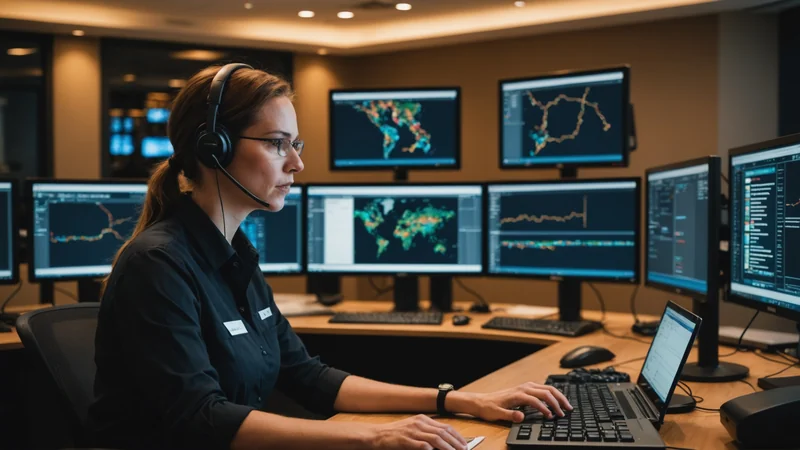
By the time a customer calls asking where their order is, the situation has already degraded. The dispatcher has to interrupt whatever they're doing, pull up the driver's last GPS ping, make a mental calculation about remaining stops, and give an estimate that may itself be wrong. In our experience, dispatchers handling a 45-truck fleet field an average of 12–18 inbound ETA requests per day by phone or email. That's between 1 and 2.5 hours of fragmented attention every single shift.
The ETA window you set at dispatch isn't a forecast. It's a commitment made with incomplete information, and it starts degrading the moment the driver leaves the yard.
How Confidence-Band ETA Prediction Works
Our approach is different from a simple GPS ETA calculator, which just takes current position and divides remaining distance by average speed. That method ignores stop dwell time variability, traffic patterns specific to individual lanes, driver behavior history, and the cascading effect of early delays on later stops.
Routevein's predictive ETA engine is a gradient-boosted model trained on delivery history per lane — we target at least 18 months of historical data to capture seasonal variation. For each active stop on a route, the model outputs not a single time but a probability distribution: a median arrival, a 25th-percentile early scenario, and a 75th-percentile late scenario. We surface this as a confidence band rather than a point estimate.
Why does that distinction matter operationally? Because the confidence band width tells you when to act. A narrow band — say, ±6 minutes — means the model is confident and no human intervention is needed. A wide band — ±35 minutes — signals high uncertainty, usually because a driver is already running late and the compounding effect on downstream stops is unpredictable. That wide-band signal is what triggers proactive customer notification.
"The goal isn't to give customers a more accurate ETA. The goal is to give them information before they have to ask for it. Those are different problems with different solutions."
The Proactive Notification Trigger
In practice, we configure a notification threshold based on the customer's preferences and the shipper's service agreements. A common setup: if the model's late scenario extends more than 20 minutes beyond the committed window, the system automatically sends a notification to the end customer with an updated delivery range. No dispatcher involvement required.
This is the mechanism that drives WISMO call reduction. The customer who would have called at 3:00 PM wondering where their delivery is instead receives a message at 2:15 PM saying "your delivery window has shifted to 4:30–5:00 PM due to traffic delays." They don't need to call because the answer arrived before the question formed.
The operational impact compounds across order volume. For a shipper running 200 deliveries per day, even a 30% reduction in WISMO call rate means roughly 60 fewer inbound contacts daily. At $10 average handling cost, that's $600 per day recovered — about $150,000 per year on a fleet of that size. We've seen fleets reduce WISMO volume by up to 40% after 60 days on the predictive ETA system.
What the Data Shows on ETA Accuracy
Median accuracy for our ETA predictions sits at ±7 minutes for stops within 90 minutes of estimated arrival, based on aggregate performance across active routes. That tightens further on dedicated lanes where we have deep historical data. High-variability routes — urban stop-dense runs with unpredictable dwell times — tend to have wider bands, which the system represents honestly rather than artificially compressing.
A few factors consistently improve accuracy:
- ELD integration: Real-time hours-of-service data lets the model account for mandatory rest stops that will affect afternoon delivery windows — something GPS alone can't predict.
- Historical dwell time per stop: Some customers consistently take 12 minutes to sign and process; others take 3. That variance accumulates across a 20-stop route. The model learns these patterns per stop ID.
- Traffic feed integration: We pull from HERE Technologies and Google Maps Platform simultaneously and weight them by recent accuracy on specific corridors. Neither feed is perfect everywhere.
- Exception feedback: When a driver manually marks a stop as "delayed — dock congestion," that signal propagates to all remaining stops immediately. The model doesn't wait for the delay to manifest in GPS drift.
TMS and Customer Portal Integration
The ETA data isn't useful if it stays inside Routevein's dashboard. We expose stop-level ETA and confidence band via API so shippers can push it into their TMS, their customer portal, or their order management system. A shipper running McLeod TMS can surface live ETAs in customer-facing order status screens without maintaining a separate tracking tool.
This integration path is where we see the largest WISMO reduction because it removes the lookup friction entirely. When customers can see a live, updating ETA on the same portal where they placed the order, the motivation to call evaporates. The shipper doesn't need to build a custom tracking page — they just need to pipe the ETA API into the portal they already operate.
For shippers without a customer portal, we provide a shareable tracking link per shipment that recipients can open on any device. The link shows the driver's current position, the next delivery, and the confidence-band ETA. It updates every 90 seconds. We've found that offering this link in the shipment confirmation email alone reduces WISMO calls by 18–25% before any predictive notification logic kicks in — because it eliminates the information asymmetry that makes customers feel they need to call.
Where ETA Predictions Struggle
We'd be doing shippers a disservice not to be honest about where the model breaks down. Unplanned events — a road closure caused by an accident 20 minutes ago, a driver who goes off-route — introduce step-change uncertainty that the model can't anticipate, only react to. Once a driver deviates, the confidence band widens dramatically until we have enough new data to re-anchor the prediction.
Seasonal anomalies are another challenge. The first major snowstorm of the season on a Midwest route always degrades accuracy because the historical data under-represents that specific weather condition. By the third or fourth storm, the model has recalibrated. But that first event — the one that typically generates the highest WISMO volume of the quarter — is also where prediction is weakest. We mitigate this by widening confidence bands automatically when weather APIs report conditions that match known degradation patterns, so at least the uncertainty is communicated rather than hidden.
The Takeaway
WISMO calls are a symptom of information gaps, not just a customer service problem. Closing those gaps requires predictions that are honest about their uncertainty — confidence bands rather than point estimates — and delivery mechanisms that push information proactively rather than waiting for customers to pull it. That's what we've built, and the 40% call reduction figure we cite isn't a projection. It's what we observe in actual fleet deployments after 60 days of operation. If your dispatchers are spending more than an hour a day answering "where is my order" questions, that time can be recovered.