The Routevein Platform
Five integrated modules — VRP solver, load consolidation, HOS compliance, TMS connector, and live re-routing — purpose-built for mid-market freight operations.
Route Optimizer
Powered by an OR-Tools-based VRP/VRPTW solver, the Route Optimizer handles the full complexity of mid-market freight networks: multi-depot configurations, time-windowed stops, pickup-and-delivery pairs, and mixed FTL/LTL loads in a single optimization pass.
500-stop networks solve in under 90 seconds. The solver accounts for real-world constraints — vehicle capacity, time windows, HOS limits, driver home-base preferences — not a simplified model of your network.
- Multi-depot vehicle routing with time windows (VRPTW)
- Pickup-and-delivery with precedence constraints
- Mixed fleet (FTL + LTL + intermodal) in one pass
- 500+ stops optimized in under 90 seconds
- Driver skill / equipment constraints
Load Consolidation
The consolidation engine evaluates each shipment against cube, weight, lane economics, and service requirements to determine whether FTL or LTL is the cost-optimal mode — then groups consolidation-eligible LTL freight into co-loads automatically.
The logic lives inside the solver, not post-planning. That means consolidation decisions interact with routing decisions — optimizing both simultaneously rather than treating them as sequential steps.
- Cube and weight threshold rules per shipment type
- Lane economics model with carrier rate tables
- Co-load grouping with time-window compatibility
- FTL vs LTL decision audit trail per shipment
12 pallets · 18,000 lbs
94% cube utilization
4 pallets · 5,200 lbs
eligible for co-load
B + C → 1 truck
5 pallets · 6,100 lbs
same lane window
HOS Compliance Engine
FMCSA Hours of Service rules are hard constraints in the Routevein solver — not a post-planning compliance check. Routes that would violate the 11-hour driving limit, 14-hour duty window, or 70-hour 8-day cycle are rejected by the solver before they're ever presented to a dispatcher.
Every route generates a DOT-audit-ready driver schedule with driving time, on-duty time, and rest break windows documented per FMCSA § 395.
- 11-hour driving / 14-hour duty window enforcement
- 70-hour 8-day cycle with daily reset tracking
- 30-minute break insertion at 8-hour driving mark
- Driver cycle state import from ELD (Samsara / Motive)
- DOT audit trail per driver per route
# HOS constraint per FMCSA § 395.3
driver_id: "DRV-0041"
cycle_hours_used: 58.5
remaining_70hr: 11.5
driving_today: 0.0
max_drive_today: 11.0
duty_window_open: "06:00"
duty_window_close: "20:00"

# Solver result: route assigned within limits
route_drive_time: 9.2 hrs
route_duty_time: 11.8 hrs ✓
break_scheduled: "13:20" 30 min
hos_status: "COMPLIANT"TMS Connector
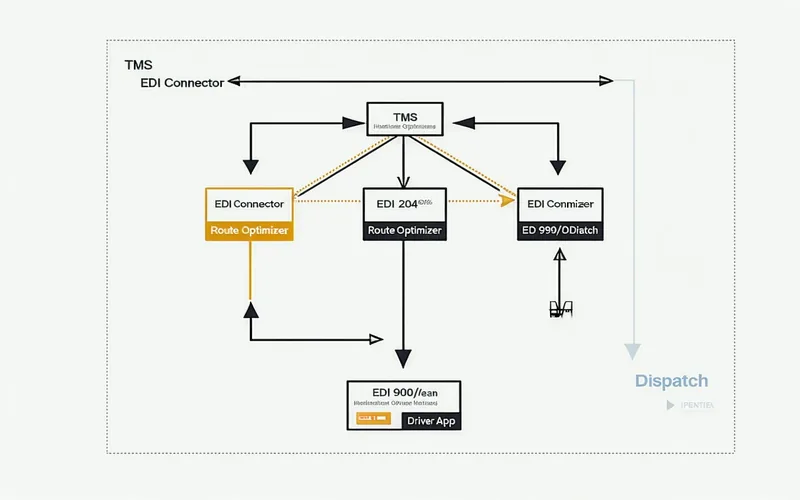
Routevein plugs into your existing TMS without replacing it. The connector handles bidirectional EDI transaction flows — receiving load tenders (EDI 204), sending acceptance/rejection (EDI 990), providing shipment status updates (EDI 214), and exchanging freight invoices (EDI 210).
Native connectors for Oracle OTM and MercuryGate TMS. REST API + webhooks for modern TMS platforms. EDI via AS2 or SFTP for legacy integrations.
We don't ask you to migrate your TMS or change your dispatch process. The solver sits alongside your existing tools and surfaces better routes. If Routevein stopped working tomorrow, your TMS would still function as it does today.
- EDI 204 (Load Tender) inbound processing
- EDI 990 (Response) with accept/reject logic
- EDI 214 (Shipment Status) outbound updates
- EDI 210 (Invoice) reconciliation
- Oracle OTM + MercuryGate native API connectors
- REST webhooks for event-driven dispatch
# EDI transaction flow
TMS  →  EDI 204  →  Routevein Solver
          Load Tender        Ingest + Optimize

Routevein  →  EDI 990  →  TMS
               Tender Accept/Reject

Driver App  →  EDI 214  →  Shipper/TMS
                Shipment Status

Carrier  →  EDI 210  →  A/P System
Freight InvoiceLive Re-routing
When disruptions hit mid-dispatch — weather events, HOS violations, mechanical breakdowns, consignee closures — Routevein re-optimizes the affected routes in real time and pushes updated manifests to drivers and load tenders back to your TMS.
The re-optimization runs in the same <90-second window as the initial solve. Dispatchers see the event, the re-routed option, and the cost delta before accepting or overriding.
- Weather API integration (NOAA / Weather.gov feeds)
- ELD-sourced HOS violation prediction (15-min lookahead)
- Consignee closure and appointment change handling
- Re-optimization in under 90 seconds
- Dispatcher override with cost-impact display
# Disruption event log
14:22:08 ALERT  HOS_PREDICT DRV-0041
         Projected violation at 18:30
         Remaining drive: 0.4 hrs
14:22:09 SOLVER Re-optimizing stops 6-8
         Affected routes: RTE-4402, RTE-4403
14:22:51 RESULT Re-route complete (43s)
         Stop 8 → reassigned DRV-0062
         Cost delta: +$87 vs violation risk
14:22:52 PUSH   EDI 204 updated tenders
Driver manifests pushedSee the platform on your actual network.
Request a 30-minute pilot. We'll model your stops, depots, and constraints — and show you the savings before you sign anything.